Showing posts with label 5 stars. Show all posts

Tuesday, August 10, 2010

Moon (2009)


This is a great week for everyone but me being right. For years, my friends, colleagues, and frenemies have been telling me I should watch The Wire, and I have said, "I will watch The Wire when I watch The Wire." Now I am watching The Wire, and you all were right, and I was stupid. Similarly, last year, while everyone I knew flipped out about Moon, I said, "Yeah, I'll get around to it." WELL, I HAVE GOTTEN AROUND TO IT, AND IT IS GREAT.

Sam Bell (Sam Rockwell) works for a company called Lunar Industries, mining helium-3, which humanity has adopted as its primary energy source. Sam is the only human part of the operation, there to inspect and maintain the automated harvesters. He's been alone on the moon for almost three years. When the movie opens, he's two weeks away from returning home, which is good, because the isolation is driving him crazy. He's started hallucinating, and one vision distracts him as he's driving out to a harvester, leading to a nasty collision. In the aftermath of the accident, he starts uncovering his employer's sinister secrets. (Ooh! Sinister! [Very sinister.])

Here are some things that Moon has:
-Sam Rockwell
-A robot
-Outer space
-Feelings
-Great production design/art direction


Moon
looks better and is better (smarter, more interesting, more emotionally compelling, etc.) than almost everything that was nominated for an Oscar last year, blah blah, arts awards are bunk. And it is more original than everything else I saw last year, with the possible exception of Logorama. People who know how fond I am of In the Loop and A Serious Man will understand how much it pains me to say that any movie exceeded them at anything, but it's true.

Watching movies like Moon is wonderful, of course, but it's also a little bit awful: it makes average movies look really bad. For a few weeks after I saw Hunger, other movies and TV shows felt mechanical and unchallenging. I'm sure that Moon will also make me bridle at the next movie I try to watch.

Moon is energetic. That's what it is. It has the scrappy intensity of a very ambitious movie made on a small budget, a fuck-you-itiveness. It says, We will show you humanity and corruption and sadness and hope. We will do it on the moon. For $5 million. And it will look goddamned fantastic.

- Loved It

Tuesday, July 20, 2010

CHEATER #1: Seen In Theaters, January-July 2010


"Cheater" is a new feature wherein I will discuss things that do not fall under the purview of this blog. This first entry is admittedly derivative of Raphael's movie rankings; when I told my roommate Muffin I was going to do this, he laughed and said, "Raphael's whole point is that he joylessly ranks things. Now you're doing the same thing and condemning yourself for unoriginality. It's like the two of you are in a contest for who can enjoy things the least." Yes, we are, and I am winning.

Five stars - Loved It


Io sono l'amore (I Am Love) - Gorgeous melodrama about a rich Milanese family. Tilda Swinton plays the matriarch, a Russian immigrant who “stopped being Russian when she came to Italy” (or [Italian] words to that effect). The movie tracks various upheavals in the Recchi family: daughter Betta’s coming out, the family company’s transfer of power and possible sale, and, foremost, Emma’s affair with her son’s friend Antonio. More than plot, though, Io sono l’amore hinges on atmosphere and feeling. I adored this movie. Near the end I thought, This is probably almost over why why why I would watch this for six hours. It’s beautiful. It’s about love (surprise!) and sex and food, and it’s stylish and thematically rich and ambiguous. It’s brilliantly conceived and brilliantly executed. The score is all John Adams, who has never allowed his music to be used in a movie before. But of course he gave permission for this movie, because this movie is a dream.


Inception - Speaking of dreams! Inception is really fucking well done. I appreciated the restraint when it came to dreamlike images; the premise of the movie is so trippy that piling more surreal visuals onto it would have felt like, well, piling on. I also appreciated Joseph Gordon-Levitt, who is talented, oh-so-fine, and apparently fixing to show the world that he can be an action hero because he can be anything. Seriously, has any young actor, past or present, controlled his/her career as deliberately and cleverly and with such simmering ambition? I have only good things to say about Joseph Gordon-Levitt. I appreciated the different levels of dreaming and the effects they had on each other.

If I were to make one criticism (and I am), it would be that DiCaprio and Cotillard's roles should have been reversed. I got uncomfortable and bummed out by the portrayal of a Strong-Willed Dude and his Lovely, Doomed Wife. Also, the love interest/antagonist character has a ball-and-chain implication that I could do with movies not attaching to women for once, especially when the love interest/antagonist gets no character development beyond that. Also also, could’ve been a lady action hero! Also also also, nothing about the characters--not even their names--would have needed to change if their genders had been flipped. But whatever. Christopher Nolan, despite being a very good director, uses female characters as obstacles, traumas, or exposition in service of his movies’ men (see: Memento, The Prestige, Inception, and especially The Dark Knight). He should work on that.


How to Train Your Dragon - Funnnnnnn. The Viking village of Berk is routinely beset by dragons. The hulking townsmen fend them off or kill them, but teenager Hiccup (Jay Baruchel) is small and nerdy. Like geeks of yore, he tries to make up for his physical weakness with technological superiority, building a catapult. During a dragon attack, Hiccup fells a Black Fury--the most elusive and powerful species of dragon. He finds the dragon the next day, injured in a nearby canyon, and they bond, much to the (eventual) chagrin of the anti-dragon residents of Berk. From there, it unfolds basically how you’d expect, and it is charming and such a pleasure to watch. All in all, a wonderful children's movie in which characters eventually recognize the oppression besetting their enemies, aid them in their revolution, and then everyone is friends and the aristocracy is dead! No? Maybe?

Four stars - Really Liked It


Winter's Bone - Ree Dolly (Jennifer Lawrence) is a seventeen-year old raising her two younger siblings and taking care of their catatonic mother. Her father, a meth cook who disappears for long stretches, has skipped bail--a bail he paid by putting his family's house up for security. Ree sets out to find him and save her family from homelessness. Few people help Ree, many try to wreck her investigation, and through all this she is a model of sympathetic strength. She's smart and kind and brave and dogged and… you know what? It is kind of weird to see a character with no discernable flaws whose every problem arises from circumstance. All the conflict in the movie happens because she refuses to give in to an impossibly cruel world. There is nothing wrong with her. And something about that just felt flat to me. I would have felt more engaged if this hadn't seemed to me the story of a saint’s martyring.

That said, I was still very engaged! I leaned forward in my seat for much or most of the movie. I cringed during the scene in the pond. I am not a robot. Jennifer Lawrence’s performance is great, as are the performances of John Hawkes as Teardrop and Dale Dickey as Merab. The script was lean, Debra Granik’s direction beautiful and stark, and overall it seemed like a great portrayal of desolation in the Ozarks, although what do I know from the Ozarks? In any case, an excellent movie that didn’t suck me in as much as I thought it should have.


Micmacs à tire-larigot (Micmacs) - Jean-Pierre Jeunet + Rube Goldbergian schemes + antipathy to the arms industry = my movie, for me. Thank you for making a movie for me, world! The sweetly awkward Bazil (Dany Boon) goes to live with a merry band of marginals in a scrap dump after his life is upended by a stray bullet in the head. They have a grand old time salvaging trash and turning it into exciting stuff, and they agree to join Bazil on a quest he happens upon: revenge against the weapons manufacturers whose products injured Bazil and killed his father (who died defusing a landmine when Bazil was a child). Micmacs is a lot of fun. The resolution is weaker than the rest of the movie, but I still came out of the theater delighted.


Please Give - Kate (Catherine Keener) and Rebecca (Rebecca Hall) are two women who are guiltily preoccupied with being good. Kate worries her wealth is parasitic: she buys dead people's furniture cheap and sells it in her fancy vintage shop; she's also waiting for her next-door neighbor to die so she can break through the wall and expand her apartment. Rebecca feels obligated to care for her sour, mean grandmother--the aforementioned dying neighbor. The main cast is filled out by their family members, none of whom have Kate or Rebecca’s “goodness” impulse. Please Give questions the usefulness of that impulse, but it also explores what it is to live without it, to be a mean grandmother, a vain sister, or an amoral husband. It’s a quotidian-lives-of-upper-middle-class-New-Yorkers kind of movie, which is not a lot of people’s bag, but I guess it is my bag? I liked this movie. The performances are strong, and the characterization is great.

Three stars - Liked It


Greenberg - Roger Greenberg (Ben Stiller) is a sad guy who is mean to everyone, including his lovely romantic interest Florence (Greta Gerwig) and his lovely friend Ivan (Rhys Ifans). I enjoyed this movie most when it was being very, very awkward but not very, very cruel. Examples: the first, abrupt sex scene and the scene in the hospital when Florence is recuperating. (The burger-on-belly bit was one of my favorite jokes ever. Fucking gold.) The movie overall, however, did not do that much for me. I really enjoyed Gerwig and Ifans’ performances, though.


Breaking Upwards - I remember liking this independent rom-com, but I’m finding it surprisingly difficult to remember anything about it! Um, it’s about a couple (Zoe Lister-Jones and Daryl Wein) attempting an open relationship and doing so messily and often thoughtlessly. It features Pablo Schreiber as a very creepy dude and Andrea Martin as a super awesome mom. It was made for something like $15,000. I thought it was good.


Predators - I am not alone when I say that the opening of this movie is the best part. Still, I had a good time watching the whole thing. The downside: Predators has a weak script. The characters are so unlikable and the challenges so insurmountable that I disengaged, the "run-get killed-run" pattern gets repetitive, and the plot twist was telegraphed by the movie's premise itself ("prey" humans are chosen for their ruthlessness, so the one gentle human will turn out to be ruthless). The upside: a strong cast. Adrien Brody makes for a really interesting action hero. Alice Braga made me sympathetic to her slight character, though not to the writers who assigned all the feelings to The Woman because of course they did. I am Walton Goggins' #1 Fan, so of course I loved him. I did not love Louis Ozawa Changchien's role, but I don't think that was his fault; his character, a Yakuza enforcer named Hanzo, was a parade of stereotypes. Laurence Fishburne makes a welcome appearance as a crazy person. Another upside to Predators is its direction. I'm not commenting on anything technical because I don't understand anything technical. What I'm saying is, "I had a good time, it looked okay, and I could tell what the fuck was going on." The trend of shooting action movies all close up and shaky irritates and confuses me, because I am 85 years old.

Two stars - Didn't Like It


Iron Man 2 - I liked this better than Iron Man, because this was shittier. I know everybody else liked Iron Man, but I didn't--perhaps because I saw it on a 13-inch computer screen with an ex-boyfriend who liked almost no movies or perhaps because its "violence is wrong; take a look at this Taliban dude on FIRE!" ethos pissed me off. Anyway, Iron Man 2 has plenty of objectionable shit--privatizing world peace? Ugh go die--but it didn't bother me, because I could not take anything seriously in the movie that featured Mickey Rourke as Angry Russian Fusion Whip Man. One might say, "Why did you take anything seriously in the first movie? It is a superhero movie!" and to that I would say, "Because, though Iron Man had a lot of explosions, it did not have enough explosions to keep the political anxiety section of my brain at bay." Did Iron Man 2 have more explosions than its predecessor? I felt like it did. It's possible that the two movies were similar but my reactions were vastly different: during Iron Man, I thought: what a waste of Jeff Bridges; during this movie, I thought, Hi, Don Cheadle and Sam Rockwell! It is nice to see you! Robert Downey, Jr. was charming in the first movie and is charming in this one. The only thing I can think to say about either the characters of Pepper Potts and Natasha Whatever or the performances of Gwyneth Paltrow and Scarlett Johansson is: how aggressively boring.


Leap Year - I did not see this in theaters, per se. I saw it on my bed, while it was in theaters (don't tell the IP police). My roommate Alice and I lay on our stomachs and played the "regressive gender politics" drinking game. Basically that means we consumed beer steadily as we watched this movie. We howled and mocked our way through it, and we had a grand old time, which puts this movie in the uncomfortable category of "this is shit, I know this is shit, I don't want Netflix to think I want to watch as many movies like this as possible, and yet I undeniably enjoyed it, though that probably just means I enjoy Alice's company." What's the star rating for that?

One star - Hated It


Clash of the Titans - Boy, did this make me feel vindicated about Sam Worthington! He is every bit as boring as I always expected but could never prove, having avoided seeing Avatar, Terminator Salvation, etc., barf. (Tangent: in February, NYT Magazine asked actors what their favorite performances of the aughts were. Answers ranged from awesome--Vera Farmiga said Michael Fassbender in Hunger--to regular--Clooney said Marion Cotillard in La Môme--to INSANE: Sam Worthington's favorite performance of the last decade was apparently Eddie Murphy in The Nutty Professor. And what's weird about that choice, apart from everything, is that The Nutty Professor was released in 1996. Perhaps he meant 2000's Nutty Professor II: the Klumps? I hope not! Sam Worthington, you are so weird.) Anyway, this movie is a ludicrous assembly of trashy special effects, terrible makeup and costumes, and a nonsensical script. I don’t think director Louis Leterrier was necessarily aiming for coherence, to be fair, but what he was aiming for, I do not know. This movie has Liam Neeson and Ralph Fiennes playing opposite each other, and even they cannot do anything to make it less of a piece of shit.

Sunday, July 4, 2010

Hunger (2008)


Well, here we go, everybody. Hunger opens with three intertitles, which say:

Not a lot of context, especially since the movie is so stingy on dialogue. I don't know much about the Troubles, generally, or about the Maze prison, specifically, so I was a little lost at first. That turned out to be completely okay. If anything, my ignorance heightened the feelings of desperation and immediacy that Hunger works to build. The movie's not apolitical, but it's also not primarily political. It's more about specific conditions and individual reactions to them. It's a microscopic examination of pain as a way of life--for prisoners and officers alike.

I just said there wasn't much dialogue in Hunger, but that's not quite true. For about 25 minutes in the middle, Hunger is all talking. But the movie before that long scene and the movie after it is light on speech and heavy on physical degradation: excretions, beatings, death. It's slow but riveting, unfolding at an oozing pace.

Basically it's a date movie.

In the first section of Hunger, we see the routines of two Republican prisoners and a guard. Their daily lives are tedious, violent, and dominated by bodily fluids. The guard often looks, rapt, at his bloody knuckles. He examines them when he smokes; he soaks them in hot water before and after his shifts. For the prisoners, their excretions are their last resort. They are years into the no wash protest, and their cell walls are thick with shit and blood. At a yelled signal, they all pour their collected urine under their doors into the H-Block hallways.

The genius of this painfully long, lovingly filmed portrayal of seeping misery is the contrast it creates with the second part of the movie: the 25-minute conversation between Bobby Sands (Michael Fassbender) and Father Dominic Moran (Liam Cunningham). Without realizing it, I had adjusted to watching violence and putrefaction, and I felt the thrill you're supposed to have during the actiony bits of movies in the one scene where no one is hitting anyone else, where there are just two people talking in a room without sticky sights or sounds.

Sands has called the priest to the prison to talk about the impending hunger strike. They banter for a while, but then they get down to the business of arguing. Father Dom thinks Bobby is being crazy and destructive; Bobby thinks Dom doesn't get it on account of living a cushy life without shit on his walls. Although the scene's between a priest and a man about to embark on an act of pseudo-Christian martyrdom, the conversation's aggressively secular. They talk about the propaganda value of the hunger strike. They talk about attempting negotiations with the British government. When Sands asks, detached and skeptical, "God's gonna punish me?" Father Dom responds, "Well, if not just for the suicide, then he'd have to punish you for stupidity." It is a really good scene, you guys.

The talk ends, and the last section of the movie begins with a doctor describing how a hungry body shuts down. Then we see Sands starve. It's really, really brutal, and it feels really, really long (it's actually just under 20 minutes--shorter than the Father Dom scene). As Sands flickers out, we see his memory/vision of himself as a child in the countryside. I could have done without that. It's a callback to the end of his conversation with the priest, and it's not that sentimental, but it's still too sentimental for me. This movie's so tough to watch; I didn't want anything that felt like a relief from that. Little Bobby in the field felt to me like a lone distraction in an otherwise single-minded movie. Steve McQueen, the director, said in an interview that he "wanted to get out of that prison cell" and give "people a chance to breathe," but I didn't want a chance to breathe at minute 123 of this 125-minute beast.

Sands' exchange with the priest is definitely my favorite part of the movie. Not just because it is mercifully free of fecal sculpture and running sores, but because DAMN is that some acting and DAMN is that some writing. Fassbender and Cunningham perform this smart, emotional scene with passion and nuance. The intensity is amplified by the famous seventeen-minute take; for most of the scene, the two actors share the frame, the camera fixed, their profiles in shadow (see below). They're so expressive, but you don't see their faces very clearly. You feel the urgency and conviction in the words, their voices, and the tilt of their bodies.


(Look, I feel really weird about the tags for this: I don't want to rate it. Five stars, I guess? It is superbly put-together and made me have a lot of feelings, so I'm not sure what more I could ask. And while it fails the Bechdel test, so what, you know? Almost no one talks in this movie. There's one long conversation. Apart from that, you could count the intelligible lines on two hands--one hand if you don't count the audio clips of Margaret Thatcher.)

Friday, June 25, 2010

The Lady Eve (1941)


I have always dreaded old movies. When I was little, I didn't like black-and-white. No idea why. Then I grew up (relatively speaking), and suddenly I loved black-and-white movies but whoops also feminism. Movies made now are bad enough in the way they treat ladies, but most of the pre-1960 stuff I've seen is nightmarish. (This may be because I haven't seen that many old movies. Because I avoid them.) Anyway, I went into The Lady Eve assuming that the gender politics would make me miserable, but they didn't! They were decent enough that I could just pay attention to whether I liked the movie or not, and I did because it's awesome.

Charlie Pike (Henry Fonda) is the heir to an ale (not beer) fortune. Jean Harrington (Barbara Stanwyck) and her dad are card-sharps: she reels rich men in, and her father takes them at poker for large sums of money. Charlie is their mark on a cruise from South America to… North America. But OH NO Jean falls in love with this sucker, and she insists that they not steal his money, and she's going to marry him but OH NO he finds out the truth (minus the she-loves-him part) and wants nothing to do with her. Then she goes after him--for revenge? Or to win him back? THE LADY EVE coming soon to computers near you.

The timeline of their romance is insane, but I assume they don't call the genre "screwball" because of its realism. Speaking of screwball, Henry Fonda delivers some pretty decent physical comedy in this movie, you guys! I didn't know Juror #8 had it in him. He's always tripping over stuff (get it? The Lady Eve. The fall. Get it? Get it?), and there's one scene where he keeps getting food all over his nice jackets. Haha! Fonda also manages the impressive trick of making his character seem likable and reasonably intelligent. Pause for a moment and consider: that is an amazing feat. The most casual examination reveals that Charlie Pike is a bland, credulous boob. Have you seen the Branagh Much Ado About Nothing? It's like that: Claudio's a piece of shit, but Robert Sean Leonard's performance makes the character seem more decent than really makes sense. Charlie (Fonda) is a less-horrible Claudio figure--gullible, boring, jealous (but not so jealous and angry that he publicly humiliates his fiancée and doesn't mind causing her apparent death SPOILER ALERT). I've digressed. What I was trying to say is that, in defiance of reason, Henry Fonda sells this character as a cool guy who maybe even deserves Barbara Stanwyck, which he doesn't because no one deserves Barbara Stanwyck.

Oh, Barbara Stanwyck, you electric being. I am in love now. Stanwyck's character is so quick, so sexy, and so confident, and watching her, I could only imagine that Stanwyck was more Jean than Jean. Which she might not have been because acting is not the same as living, but the performance was good enough to make me think stupid thoughts.

Circling back to the gender shit at the beginning of this post, I really want to express my gratitude to this movie/Preston Sturges/everyone involved for not being awful. Charlie Pike does not spend the movie talking down to Jean--you know, the "listen, little lady" bullshit. Also, he gets really mad at her at several points in the movie, but he never threatens to hit her. Holy fucking Moses. How incredible is that? Thanks, It Happened One Night, for making me astonished by basic humane behavior in olde tyme pictures.

Thursday, June 3, 2010

El Espíritu de la Colmena (The Spirit of the Beehive) (1973)


Two things about this movie:
1. I did not understand it at all.
2. I loved it.

Six-year-old Ana (Ana Torrent) lives in a Castilian village in newly Francoist Spain. At/near the beginning of the movie, she sees James Whale's Frankenstein and is captivated by it. When she and her sister Isabel (Isabel Tellería) are laying in bed that night, Ana asks the older girl about the motives of the monster and the mob. She wants to know why violence happened--why the monster kills the girl, why the people kill the monster. Isabel doesn't know, but when Ana accuses her of ignorance, Isabel reacts by lying: the monster is alive, and he lives nearby!

You guys, this is great. The characters of Ana and Isabel are maybe my favorite depictions of childhood in any movie I've ever seen. (Plus, fun side effect of making two prepubescent girls the main characters: this film passes the Bechdel test so hard.)

Ana becomes preoccupied with the monster, whom she wants to befriend. And Isabel elaborates on her lie, of course. Here's how you summon the monster. Here's where the monster lives. Ana returns to the abandoned building--the monster's house--without her sister. She looks around, and you can see that she's hesitant, nearing skeptical. But she sees a footprint that's gargantuan in comparison with her own tiny foot, and an incredibly subtle change comes over her face. I got so excited in that moment. She's on the verge of knowing better, but she pulls back just in time.

Look, I could happily describe how each scene of this movie made me feel, but that would be ridiculous, so I'm just going to say that there's a lot of important, loaded stuff in this movie: mushrooms, loneliness, a Republican soldier, bees, a family in pieces. If symbolism were physically dense in the same way as celestial bodies, this movie would be a fucking neutron star. I'm often impatient with that sort of thing, but this time I was too busy being engrossed. And this movie--because it is really, really good--is 100% enjoyable even if you, like me, know nothing about fascism, Spain, or filmmaking. The acting, writing, and direction are as confident as they are understated; the cinematography (by Luis Cuadrado) and music (by Luis de Pablo) are flawless. If I recommend this movie any harder, I am going to pull a muscle.

El Espíritu de la Colmena could have been prescribed to me as medicine. When I watched it yesterday, I was so sad, and I needed something as sad as I was--but still undespairing. And frankly, I needed to see something that made me feel but didn't even try to make me understand.

Thursday, May 20, 2010

Who Am I This Time? (1982)


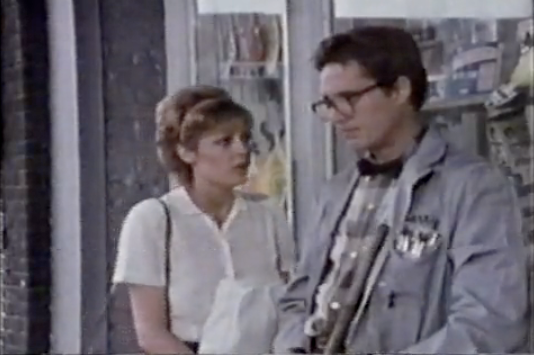
In the darkest, earliest eighties, Jonathan Demme, Christopher Walken, Susan Sarandon, and John Cale got together to make an episode of American Playhouse based on a Kurt Vonnegut short story. If that does not sound like heaven to you, please know that we see the world very differently. Disregard the rest of this review.

Basically it's a sweet shortish movie about a boy and a girl who fall in love. Walken plays Harry Nash, the star of all his small town's community theater productions. Offstage, Harry is a hardware store clerk with paralyzing social anxiety. Helene Shaw (Sarandon) is new to town and gets recruited to play Stella in A Streetcar Named Desire. (Harry's playing Stanley, of course.) She falls in love with him and is super sad when she finds out that he won't ever talk to her because he won't ever talk to anyone outside of plays.

BUT SPOILER ALERT SHE FINDS A WAY AROUND THIS, A WAY TO MAKE THEIR ROMANCE BLOOM. Can you figure out how? Probably you can, yes.

Honestly, this TV movie doesn't quite fill its 55 minutes, but I don't care. This shit is just too adorable. It is the most adorable.