I saw a preview screening of Butter, an indie-but-not-really-indie comedy that's coming out next year. My friend and Butter date Josh says I'm not supposed to talk about it online, but whatever. That ship has sailed.
Butter is about two ladies who enter a butter-carving competition. I liked it (mostly, ish) while I was watching it, but in retrospect, my impressions are kind of negative? This definitely says more about me than about Butter. Below I will rank stuff I remember about it from best to worst:
1. Olivia Wilde as an angry stripper. The characterization of "stripper" is pretty lazy, but she's still hilarious.
2. There are very sweet scenes between Yara Shahidi, who plays the hero of the movie, and Rob Corddry, who plays her Cool Foster Dad. He was so cool that he made me wish I'd been in foster care! (No, not really. But he was very cool.)
3. I definitely remember that there were some funny lines of dialogue. So.
4. Ashley Greene was not bad, but she didn't have enough screen time. But she definitely makes out with Olivia Wilde during her limited screen time, and that is pretty great.
5. Hugh Jackman plays this weird superfluous character who has weird superfluous scenes. Like in one he sits in his car showroom and thanks God for letting him fuck Jennifer Garner. I don't even know.
6. The movie relies pretty heavily on tired Hollywood nonsense. FOR EXAMPLE: the movie opens with a boring voiceover over headless footage of fat people! Yay! Are these fat people relevant to the movie? Does the movie criticize overconsumption? Should writers be forced to prove to some centralized body that they actually deserve to use voiceover? No, no, and yes, respectively.
7. Jennifer Garner's character suuuuuuuuuuuucks. Basically a Sarah Palin type, but more two-dimensional and more neurotic.
8. Heard recently that the movie's supposed to parallel the Clinton/Obama primary. If that is true, that blows. "Oh, Hillary Clinton, what a bitch." -the filmmakers, right before they ATE ME

Showing posts with label bechdel PASS. Show all posts
Showing posts with label bechdel PASS. Show all posts
Sunday, October 3, 2010

Sunday, August 29, 2010
Män som hatar kvinnor (The Girl with the Dragon Tattoo) (2009)

Lisbeth Salander (Noomi Rapace, in an awesome performance), a researcher/hacker with a criminal past, works for a large security firm. She's been assigned to spy on Mikael Blomkvist (Michael Nyqvist), a journalist recently convicted of libel. After she gives the information she's gathered on Blomkvist to a lawyer named Frode, Frode approaches Blomkvist on behalf of his client, Henrik Vanger. The ultra-wealthy Vanger hires Blomkvist to spend the months leading up to his prison sentence investigating the murder of Harriet Vanger--Henrik's niece. Blomkvist moves to the island of Hedebey, home of Henrik and family, and begins to dig.
He doesn't find much on his own, but Lisbeth, still hacking his computer, figures out a clue and e-mails him. Blomkvist, annoyed but intrigued, shows up at Lisbeth's door and gets her to join his investigation. Together, they are the best crime-solving team ever, uncovering a series of gruesome murders on their way to solving the Harriet mystery.
Before Lisbeth joins up with Blomkvist, there's a subplot where she has to deal with a new probationary guardian. From his first appearance, it is clear that this man--Bjurman--is controlling, sadistic, and an all-around winner. Lisbeth's interactions with him felt like the scariest, highest-stakes part of the movie. He's not central to the plot, but he is the clearest and earliest indication of the movie's big theme: misogyny. The Swedish title of the movie (and of the original book) means "Men Who Hate Women." I think this is pretty funny; I can imagine the English-language publisher saying, "Nope! Nope! No! Call it something else; call it anything else. The Girl with the Dragon Tattoo? Great. Print."
Men Who Hate Women Including the One with the Dragon Tattoo does an exceptionally good job of using vagueness to build suspense. The Vanger Group's business looms over the entire movie, yet I don't remember what kind of business it was. Are we ever told? Similarly, the infrequency of Blomkvist's contact with Vanger family members added to the unease I felt about them. It's really unnerving when Blomkvist is summoned to a meeting with the assembled Vangers, severe middle-aged and elderly strangers staring him down in an underlit living room. Henrik's brother Harald is the only Vanger on Hedebey who doesn't go to that creepy meeting--which makes him even creepier. Harald is the movie's bogeyman. He's mentioned often, and his house is an imposing presence on the island. He can't be overlooked, but he can't be seen, either. It's a really typical way of building up fear of a character, so I feel weird making a thing of it, but I thought this movie carried it off particularly well.
In general, The Girl with the Dragon Tattoo uses familiar tricks but makes them feel compelling, not worn. Some of the plot developments were predictable--who was sending the pressed flowers, Lisbeth's violent crime--but that didn't bother me or make me enjoy the movie less. Plus, let's be real: it is incredibly refreshing to see a thriller about misogyny rather than a thriller filled with misogyny.
 - Really Liked It
Wednesday, July 14, 2010
Avatar: the Last Airbender, Book 1: Water (2005)

This show's okay, but I did feel like it had too few white people? You know how that is, when you're watching some mainstream Hollywood entertainment and you're just like, "Damn. So many people of color." It's not that big a deal, but if they were to adapt this into a movie, my one recommendation would be "more white people." If I were permitted to elaborate, my recommendation would be "more white people except make the Fire Nation genero-brown. A sort of South Asian/Middle Eastern/Latino group. I would find those racial politics more palatable--and current!" That would be my recommendation.
Just kidding, everybody! I am simply making a timely (nope) joke about The Last Airbender, a movie so nice that it has a lower RottenTomatoes score than Jonah Hex. Terrible though the movie may be (going off of conventional wisdom here; I haven't seen it), the Nickelodeon cartoon on which it's based, Avatar: the Last Airbender, is really good.
Avatar: The Last Airbender is about a kid named Aang (Zach Tyler Eisen) who's supposed to save the world. His world is made up of four countries: the Water Tribes, the Earth Kingdom, the Fire Nation, and the Air Nomads. (I question the structure of these nation-states: while the Earth and Fire countries are contiguous, the Water and Air territories are far-flung, at opposite ends of the map and separated by Fire and Earth lands. How, exactly, did the widespread Water and Air cultures develop similarly? Did they start in one area, then colonize the others? Also, while the Earth Kingdom is multiethnic, the other three populations seem to be homogenous. Maybe?) ANYWAY: a small minority of each country's populations are "benders"--people who can "bend" one element to their will, using Chinese martial arts. The Avatar is the one person who can learn to bend all four elements.
At the beginning of the series, Aang has been frozen for 100 years (along with his giant six-legged flying bison Appa) in a huge ball o' ice at the South Pole. He's discovered by Katara (Mae Whitman) and Sokka (Jack DeSena), two teenage members of the Southern Water Tribe. Katara is a Waterbender. Sokka is a Xander--sometimes heroic, but lacking in superpowers and typically used for comic relief. The 100 years that Aang missed were pretty important, on account of the Fire Nation went genocidal and exterminated his Air diaspora peoples. The Fire Nation has also been waging war on the Water Tribe and Earth Kingdom for a century, but the Water and Earth people aren't as bad off as the Air people (i.e. they still exist).
The show follows Aang's quest to master all four bending disciplines and defeat the evil Fire Lord. He is accompanied by Katara and Sokka and pursued by the Javert-ian Prince Zuko (Dante Basco), heir to the Fire Nation throne. Zuko has been banished by his dick Fire Lord father, and he can only regain his honor and return home if he captures the Avatar.
This is a really fun show, and the second half of the season is especially impressive. I tried to make a list of my favorite episodes of the season but quickly realized that my favorites were pretty much "episode 10 through 18," which is too many favorites. Oddly, some of my favorite episodes are allegorical: "The Great Divide" explores conflict and subjectivity; it follows two feuding tribes as they are forced to cross a treacherous canyon together. That kind of story (especially in kids' TV) usually feels heavy-handed to me, but this one is thoughtful and interesting. Likewise "Jet" and "Bato of the Water Tribe"--two episodes that examine trust from different angles. These episodes could easily have descended into preachiness but don't. Avatar is notable for its strong plots and lack of condescension.
This show also has badass gadgets! In "The Northern Air Temple," the Fire Nation has these tanks where if you flip them over, the center bit where the humans hang out flips over, too. I'm explaining this poorly, but the way this goes down is the good guys manage to flip over a tank, and they're like YES but then the middle of the tank flips itself, the tracks keep on rolling, and the good guys are like OH SHIT. It is very cool! That whole episode is replete with steampunk insanity and delightful designs.
The one other thing I want to talk about in Avatar: the Last Airbender is FEMINISM. (Sorry this is so haphazard, by the way, but it is pretty hard to review a whole season at once, especially when you are not putting in the time and effort to write something well [see: me, right now].) FEMINISM is important in this cartoon, as exemplified by episode 18, which I think is called "The Waterbending Master," but I'm not going to double-check, and I don't know for sure because while I wrote down other episode titles in my notes, here I only wrote "118 - fuck you patriarchy."
The main conflict in "The Waterbending Master" is that Aang and Katara have traveled no joke across the fucking EARTH to study with this dude named Master Paku, but when they get to the Northern Water Tribe (which, incidentally, is Polar Venice--bridges and canals carved out of ice; it's great), Paku says he'll only teach Aang. "In my culture ladies are not allowed to learn to water-fight. Go learn how to water-heal, you vagina." Katara and Aang's shared position on this is "are you a fucking joke," which makes sense, because they traveled the entire distance of the world for this purpose and now sexism what the shit.
Katara gets mad, Aang says that he's not going to study with an asshole who won't teach ladies, and Katara says, "wait, no, that's a bad idea because the world will end if you don't learn waterbending." She resigns herself to not learning for all of 6 hours or something, but then she and Aang decide that, every night, he'll just teach her what he learned that day. Master Paku catches them immediately, gets super angry, and kicks Aang out of his class. Katara and Aang go before a tribunal or some shit to appeal this, and the chief says that maybe Paku would take Aang back if "you [i.e. Katara] swallow your pride and apologize." Through his shit-eating grin, Paku says, "I'm waiting, little girl." And a vein bursts in Katara's temple and instead of "I'm sorry," she is more like "FUCK YOU; P.S. PISTOLS AT DAWN." So then she fights this incredible master, right, even though she only knows a little waterbending. And she does such a good job! He still hands her her ass, but first she bends like she's never bent before.
The fight doesn't convince Paku that he's an ass, but his discovery that Katara's grandmother is his long-lost betrothed what ran away to the Southern Water Tribe does convince him because Katara seizes on the opportunity to say, "CLEARLY SHE LEFT YOU BECAUSE OF PATRIARCHY." Harsh? Yes, but Paku immediately shapes the fuck up and teaches her waterbending. Result! Now, what's interesting about all this is that before fighting Paku, Katara is a less capable waterbender than Aang. She starts the series knowing more, but his learning curve is much steeper. Post-Paku-conflict, Katara becomes the bomb. She is better at waterbending than Aang. She is the best. One could interpret this as an inconsistency, but I see it this way instead: her "come to Jesus" moment ("come to Jesus" = "feminist epiphany") has opened the floodgates and revealed her amazing latent power. POTENT METAPHOR YOU GUYS.
Friday, June 11, 2010
Frozen River (2008)

I'm going to make this one brief because I want to stop thinking about this movie as soon as possible. Look: it is a good movie. I am not criticizing its movieness. But it is just so sad.
It is too sad.
Okay, so here's this very sad movie, quickly: Ray (Melissa Leo) is fraying from her efforts to support herself and her two sons. Out of desperation (which desperation is painstakingly, lovingly depicted on screen), Ray resorts to smuggling Asian immigrants through an Indian reservation across the Canada-U.S. border. Her, um, partner in crime, I guess, is Lila (Misty Upham), a similarly miserable, trapped woman.
This is a feature-length trek through grinding poverty. It is not pleasant to watch. It is unremittingly bleak. Well, not quite unremittingly. There is a little bit of remitting. At the very end.
I mean, good job everyone involved. The acting's great: Leo is fucking ridiculous. It is such a good performance. If you know me, you know that I am deeply in love with Kate Winslet and was thrilled when she finally won her Oscar, but 1) she won it in the incorrect category (her role in The Reader was supporting) and 2) if she was gonna get stuck in Best Actress, she deserved to lose. Sorry, Kate Winslet; I still love you. But Melissa Leo breaks my heart as Ray.
Courtney Hunt, the writer-director, also deserves massive, massive credit, for, among other things, writing the character of Ray--one of the more richly developed roles I've seen in a long time. And if we're talking specifically about roles for women... shit, this is leaps and bounds ahead of everything else.
Okay, before I end this, I also want to mention the wonderful performances of Misty Upham as Lila and Charlie McDermott as Ray's teenage son T.J. When I finished watching this movie, I wondered what else McDermott had been in. Is he great in other things? Is he in other great things? Well, apparently he is a regular on The Middle, a show whose existence and success are as depressing as the plot of Frozen River.
Thursday, June 10, 2010
The Brother From Another Planet (1984)
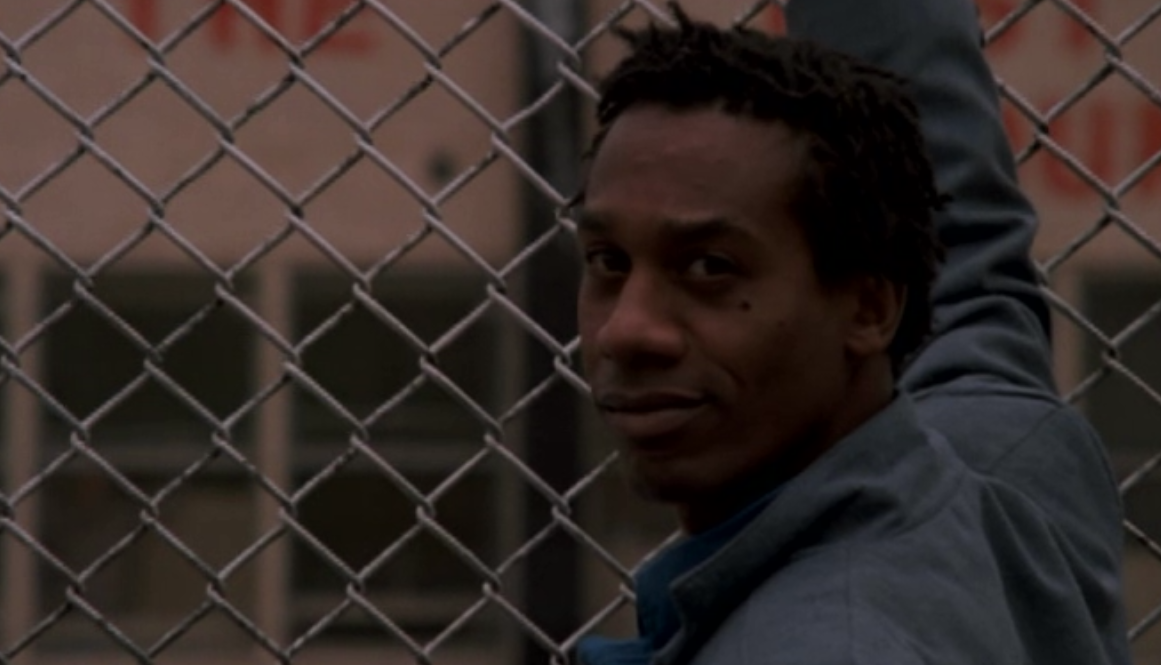
How fun was this. The Brother From Another Planet is about an alien refugee (Joe Morton) who crashes in the harbor off of Ellis Island. He makes his way (by chance, I guess, though the geography's a little suspect) to Harlem, where he has Problems because he doesn't understand Human Ways (like money) and also he's mute. But then he wanders into a bar populated with quirky regulars, and they adopt him!
We follow the Brother through his mundane travails (finding somewhere to live, a job), his weirdo quests (some stuff with drug dealers, some other stuff with a lady), and his pursuit by two bounty hunters, the Men in Black (John Sayles and the perennially foxy David Strathairn).
Fish-out-of-water scenes are, of course, obligatory for this kind of movie, and they often feel hackneyed. Not so here. In the hands of Sayles, Morton, and Strathairn, everything is fresh. I giggled the maximum amount when the Brother saw a crucifix for the first time. (Morton's reaction shots are always dynamite, actually.) There's also a very funny exchange between the Men in Black and the bartender, Odell:
Man 1: Beer.Now, this may just seem okay amusing, but Sayles and Strathairn's delivery really sells it: they're totally deadpan, but they still convey a confused panic at the bartender's question--and then Sayles' alien recovers with misplaced confidence: "On the rocks." ON THE ROCKS YOU GUYS. FOR BEER. OH THE HUMOR. No, really, it's a very funny scene.
Odell: What kind?
Man 2: Draft.
Man 1: On the rocks.
 A very funny scene.
The beer scene is a great way of introducing these two creepy villains. They are the vague menace hovering over the story, and while they're intimidating, no one is so frightened as to cooperate with them. This is one of my favorite running not-quite-gags in the movie, and it reaches its peak when they try to question a public servant about the Brother. She looks nervous for a second, and then she dispatches them with piles of paperwork and requests for verification of identity and employment.
The movie is admittedly uneven: its low-budget-ness, which really shines in the simple approach to alien tech (e.g. the Brother's eyeball surveillance, the Men in Black's imaginative alien fishing reel), makes for a pretty fucking boring climactic chase sequence. Also, I did not so much enjoy the drug subplot, which includes an atmospheric (by which I mean "tedious") tour of nighttime Harlem and culminates in the Brother doing something that made me very uncomfortable.
BUT: those few things aside, this movie has a lot of heart. It's filled with fun characters, and Morton holds everything together expertly. I don't think I can praise his performance enough: he's expressive, charismatic, sympathetic--and silent.
Finally, I have to end with some cool trivia: Joe Morton has the distinction of being the first actor to appear in two movies reviewed on this blog. (He played Keanu Reeves' commanding officer in Speed.) Also, John Sayles is clearly campaigning to be my new favorite director. Item 1: I liked this movie a lot. Item 2: he self-finances his movies by doctoring scripts. Item 3: IMDb informs me that in a poll two years ago, Mr. Sayles said that The Spirit of the Beehive is one of his 10 favorite movies. BOOM. Great job, John Sayles.
Thursday, June 3, 2010
El Espíritu de la Colmena (The Spirit of the Beehive) (1973)

Two things about this movie:
1. I did not understand it at all.
2. I loved it.
Six-year-old Ana (Ana Torrent) lives in a Castilian village in newly Francoist Spain. At/near the beginning of the movie, she sees James Whale's Frankenstein and is captivated by it. When she and her sister Isabel (Isabel Tellería) are laying in bed that night, Ana asks the older girl about the motives of the monster and the mob. She wants to know why violence happened--why the monster kills the girl, why the people kill the monster. Isabel doesn't know, but when Ana accuses her of ignorance, Isabel reacts by lying: the monster is alive, and he lives nearby!
You guys, this is great. The characters of Ana and Isabel are maybe my favorite depictions of childhood in any movie I've ever seen. (Plus, fun side effect of making two prepubescent girls the main characters: this film passes the Bechdel test so hard.)
Ana becomes preoccupied with the monster, whom she wants to befriend. And Isabel elaborates on her lie, of course. Here's how you summon the monster. Here's where the monster lives. Ana returns to the abandoned building--the monster's house--without her sister. She looks around, and you can see that she's hesitant, nearing skeptical. But she sees a footprint that's gargantuan in comparison with her own tiny foot, and an incredibly subtle change comes over her face. I got so excited in that moment. She's on the verge of knowing better, but she pulls back just in time.
Look, I could happily describe how each scene of this movie made me feel, but that would be ridiculous, so I'm just going to say that there's a lot of important, loaded stuff in this movie: mushrooms, loneliness, a Republican soldier, bees, a family in pieces. If symbolism were physically dense in the same way as celestial bodies, this movie would be a fucking neutron star. I'm often impatient with that sort of thing, but this time I was too busy being engrossed. And this movie--because it is really, really good--is 100% enjoyable even if you, like me, know nothing about fascism, Spain, or filmmaking. The acting, writing, and direction are as confident as they are understated; the cinematography (by Luis Cuadrado) and music (by Luis de Pablo) are flawless. If I recommend this movie any harder, I am going to pull a muscle.
El Espíritu de la Colmena could have been prescribed to me as medicine. When I watched it yesterday, I was so sad, and I needed something as sad as I was--but still undespairing. And frankly, I needed to see something that made me feel but didn't even try to make me understand.
Sunday, May 30, 2010
Speed (1994)
 Or, as Eddie Izzard calls it, "La Vitesse."
This movie was pretty fucking deep, you guys. That is why I have not written in a week. It is because I have been PROCESSING.
Speed is about a man named Keanu Reeves, who is a brave cop but a terrible driver. He first appears in the movie flying over the San Francisco pavement to get to a hostagey bomby kind of situation. By "flying," I do not mean "driving quickly." I mean that he is airborne, in violation of the laws of God and man. Anyway, Keanu Reeves can't be great at everything. He shows up at a skyscraper with his partner Jeff Daniels, and they're sent to figure out how a crazy terrorist (Dennis Hopper) is planning to kill a bunch of people in an elevator. Their job, again: figure out what Dennis Hopper is doing. But Keanu's all, "Let's fix this ourselves, right now, just the two of us, because that is how hostage situations are resolved: with cranes and jumping." SPOILER ALERT: it is good that he goes all rogue on the saving-people portion of the evening but stupid that he tries to go after Dennis Hopper without reinforcements. As far as I can tell? Anyway, it doesn't really work out. Dennis Hopper gets Keanu to shoot Jeff Daniels, escapes in an explosion, and now has a shiny new vendetta against Our Hero.
The rest of the movie: Dennis Hopper blows up a bus, calls Keanu to tell him about another bus that will blow up if… you know the rest. Keanu tries to get to the bus before it reaches 50 mph, but he sucks, so then he has to jump onto the bus and keep it above 50. The driver gets shot, which means someone else has to drive! Will it be Keanu? As we all know, a fundamental rule of drama is that if Chekhov's Terrible Driver is placed on the wall in act one, he must drive terribly in act two. But no, disaster averted: Sandra Bullock drives instead. So we have bus shenanigans for a while (featuring Beth Grant!), and then the movie wraps up with a train thingy, okay done.
Before I saw Speed, I'd only heard about the crazy driving parts, not the elevator and train set pieces. There's a reason for that: the bus is the fun part of Speed. I don't know why the other bits go on so long, honestly. This movie is two hours, which seems pretty long for an action movie that should be 90 minutes.
The characters: Officer Keanu Reeves is such a dick. My goodness. He is always saying things like "C'mon, Jeff Daniels, save my life," when ostensibly he should be most worried about the ten or fifteen civilians on the bus with him (and also Jeff Daniels has his own shit to worry about, you know?). Plus at the beginning, he suggests shooting (hypothetical) hostages to "take them out of the equation."
 Dick.
Dick.Dennis the Terrorist Menace confused me. He says shit that's supposed to be intimidating but isn't particularly. I mean, he's trying to blow up a dozen people. He's intimidating. But nothing is added by lines like, "It's getting on to 11 A.M., and I think it's going to be a very pretty day. HAHAHAHAHA!" Okay? Okay, I guess, Dennis Hopper. A solid B-.
 Frank Booth Memorial Blog Entry
Sandra "Driverface" Bullock brings the charm, of course. I liked that she was the bus driver. She helped save everybody, you guys! But then OF COURSE we can't leave well enough alone; Keanu, who has already saved her by SPOILER ALERT getting people off the bus, has to save her harder on a train. Ugh. Apparently Joss Whedon was a script doctor for Speed, and he overhauled the end, so what the hell, dude. I expect better from you. ANYWAY: none of that was Sandy's fault. In the hilarious words of an IMDB commenter: "Sandra is a delight to watch as well as hear - she has a voice you literally can wrap yourself up in." Perhaps not, but a fine performance nonetheless.
 1994 was a crazy time: Dennis Hopper was credited above this powerhouse.
But, hands down, the two best characters: the Out-of-Towner (Alan Ruck) and Ortiz (Carlos Carrasco). The Out-of-Towner is, as you'd expect, a white-bread middle America kinda guy visiting L.A. for the first time and look what happens to him. Ortiz is the laconic Angeleno sitting next to him. Their chemistry is fan-fucking-tastic. Out-of-Towner says shit like, "Your tax dollars are paying [police] salaries! If we die, they gotta take a pay cut!" and Ortiz is all "LULZ O'CLOCK." Speed is pretty fun, but it would have been a MODERN CLASSIC if these two had been the main characters. An odd couple story about two wacky dudes stuck on a bus that might blow up! WHAT A GREAT MOVIE.
 I think this is the beginning of a beautiful friendship.
Subscribe to:
Posts (Atom)